


Our Ranger Raptor Just Made 565 WHP on Garrett PowerMax Turbos


We have been building our Ranger Raptor R&D truck piece by piece, and Episode 2 of the series is where things got loud. After Ranger Raptor R&D Build EP. 1 covered the stock baseline and Stage 2 numbers, this round was all about bolting on Garrett PowerMax turbos, upgrading the fuel system, and strapping it to the dyno to see what this 3.0L EcoBoost platform can really do. The result: 565 whp and 600 ft-lbs of torque on E90 fuel. Here is exactly how we got there.
Suspension First: Foutz Motorsports Gets the Ranger Raptor Ready
Before we touched the powertrain, we wanted this truck properly protected. We took it to Greg Foutz at Foutz Motorsports in Mesa, Arizona. If you are not familiar with Greg, he helped develop and race the first Raptor prototype for the 2009 Baja 1000. The guy is one of the reasons the Ford Raptor exists as a production truck. We are lucky to have him here in Arizona.
We had Foutz install upper control arms, heavy-duty tie rods (the factory ones are known to flex under hard off-road use), trailing arms out back, and a full set of skid plates underneath. We also got the shock ride height sensors unblocked. For whatever reason, Ford left those blocked from the factory on the Ranger Raptor, so Foutz sorted that out too.

Yes, all of this adds weight. If you are chasing drag times, you are pulling parts off. But we drive our trucks off-road. Protection and durability come first, and that means putting weight on. That is how we build.

Garrett PowerMax Turbo Install at Full Race
With the suspension sorted, we loaded up the truck and headed to Full Race Motorsports in Phoenix for the Ranger Raptor turbo upgrade. Full Race has been building turbo systems since 2003, and as of 2026, they have started doing installs again after years of focusing purely on parts development and off-road product lines. Our truck was the first Ranger Raptor to get Garrett PowerMax turbos installed at their shop.

The Garrett PowerMax GT1752S turbos use a 41mm compressor inducer versus the stock 38mm, giving about 18% more airflow without any custom fabrication. They are a direct bolt-on for the 3.0L EcoBoost. Garrett originally designed them for the 2.7L platform, but the jump from 3.0 to this turbo set is smaller than from a 2.7, so you really do not lose any spool. That was a big deal for us. We want this truck to feel responsive everywhere, especially off-road where turbo lag would be a problem.
Along with the turbos, we installed SPD catted downpipes, CVF charge pipes (inlet tubes), a TurboSmart BOV, and kept our COBB intercooler and S&B intake from the Stage 2 setup.
Fuel System: Nostrum Stage 3 on E90
For fuel, we went with the Nostrum Stage 3 kit. This is not the full Goliath setup. The Stage 3 uses a smaller high-pressure fuel pump, but the injectors flow 96% more than stock, which gave us enough headroom for this round of testing on E90 fuel. We are still waiting on the Nostrum Goliath HPFP, which flows 60% more than the stock pump and is rated to support north of 750 whp on E85. Once that arrives, we will have room to push harder.
Dyno Day at APA: 565 WHP and 600 ft-lbs
We do most of our initial tuning on the street using COBB and HPTuners. We will get a few passes in, gather data, make changes, and repeat until the tune is in a good spot. Then we get on the dyno for fine-tuning. For this session, we went to APA in Phoenix.

The numbers: 565 whp and 600 ft-lbs of torque to the wheels. We capped torque at 600 to keep things safe for the transmission. For context, our buddy Matt's Bronco Raptor with the same turbo setup made around 470 whp, but that was measured through 38 to 40 inch tires. Our truck is on stock 33s, so the difference is partly drivetrain loss through bigger rubber.
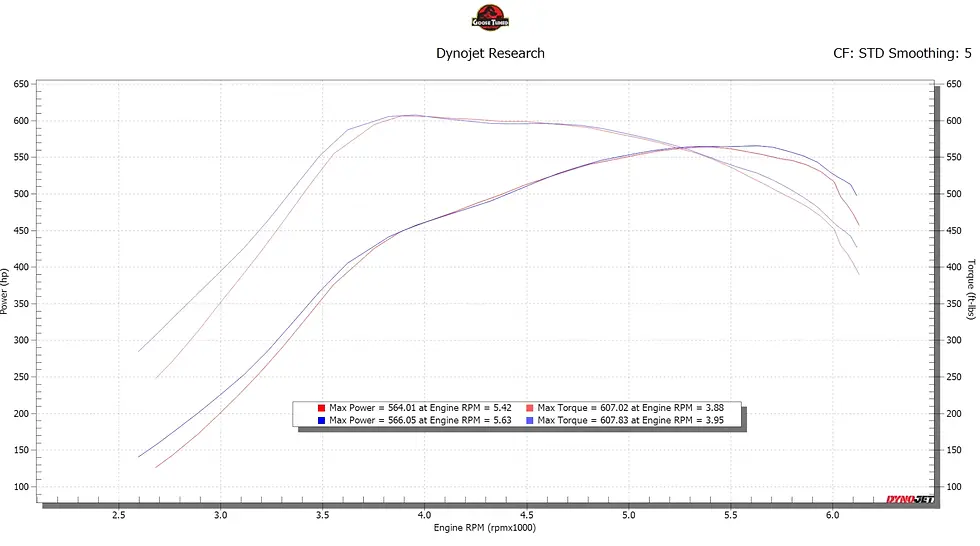
That is a massive jump from where we started. Going from a stock Ranger Raptor to 565 whp on a bolt-on turbo kit, upgraded fuel, and a proper tune. The truck still spools like factory. No lag, no dead spots in the power band. It just makes more of everything.
Full Mod List for This Build
Downpipes: SPD catted downpipes
Charge pipes: CVF inlet tubes
Intercooler: COBB factory-location FMIC
Intake: S&B
BOV: TurboSmart
Fuel: E90
Tuning: COBB & HPTuners (GooseTuned custom calibration)
Suspension: Foutz Motorsports — UCAs, tie rods, trailing arms, skid plates, ride height sensor correction
What Comes Next for Our Ranger Raptor R&D Build
We are not done. The Nostrum Goliath high-pressure fuel pump is on order. Once that is in, we will have significantly more fuel overhead to work with. We are also looking at swapping the intake to a different design to see if we can pick up power there.
Longer term, we are evaluating a bigger turbo set that is speced differently from the PowerMax units. The goal is to find something that makes more power up top while keeping the same low-end spool characteristics. For a truck this size that sees real off-road use, throttle response matters more than peak numbers. But if we can have both, even better. We may also run the truck on SDHQ's mainline dyno for an additional data point.
If you want to follow along, subscribe to our channel and stay tuned for Episode 3. And if you want this kind of power in your own Ranger Raptor or Bronco Raptor, reach out. We tune these trucks remotely using COBB and HPTuners, and we ship everything you need.
Watch the Full Build Video
The video covers everything from the Foutz Motorsports suspension install to the first dyno pull at APA. Worth watching if you want to hear the truck run and see the install process up close.
Frequently Asked Questions
How much horsepower can a Ranger Raptor make with bolt-on mods?
With Garrett PowerMax turbos, Nostrum Stage 3 injectors, SPD catted downpipes, supporting bolt-ons, and a custom E90 tune, we made 565 whp and 600 ft-lbs on our R&D Ranger Raptor. The Nostrum Goliath HPFP, which we have not yet installed, is rated to support over 750 whp on E85, so there is more headroom in this platform.
What turbos fit the Ford Ranger Raptor 3.0 EcoBoost?
The Garrett PowerMax GT1752S is a direct bolt-on turbo upgrade for the 2024+ Ranger Raptor 3.0L. It uses a 41mm compressor inducer versus the stock 38mm, flows 18% more air, and requires no cutting or fabrication. It is also CARB-certified (EO# D-871-4), making it 50-state legal.
Is the Garrett PowerMax turbo a good upgrade for the Ranger Raptor?
We think so. On our truck, spool characteristics stayed almost identical to stock, which matters if you use the truck off-road. The turbos made a meaningful power difference without adding lag or dead spots in the power band. They were originally developed for the 2.7L EcoBoost, so on the larger 3.0L they are not working as hard, which is good for reliability.
Where did GooseTuned get the Ranger Raptor turbo install done?
Full Race Motorsports in Phoenix, Arizona. They are a turbo-focused shop that has been in business since 2003. As of 2026, they have reopened their install services. Our truck was the first Ranger Raptor to get Garrett PowerMax turbos installed there.
What suspension upgrades does the GooseTuned Ranger Raptor have?
Foutz Motorsports in Mesa, AZ handled the suspension. We installed upper control arms, upgraded tie rods, trailing arms, skid plates, and corrected the factory-blocked shock ride height sensors. Greg Foutz, who helped build the original Raptor race truck for the 2009 Baja 1000, runs the shop.


Comments